
In the global automotive and industrial markets, alternators are classified into several distinct categories depending on how you look at them—whether by design structure, vehicle application, or market segmentation.
Understanding these classifications is crucial for accurate product positioning, technical sourcing, distribution business, and meeting specific importer requirements.
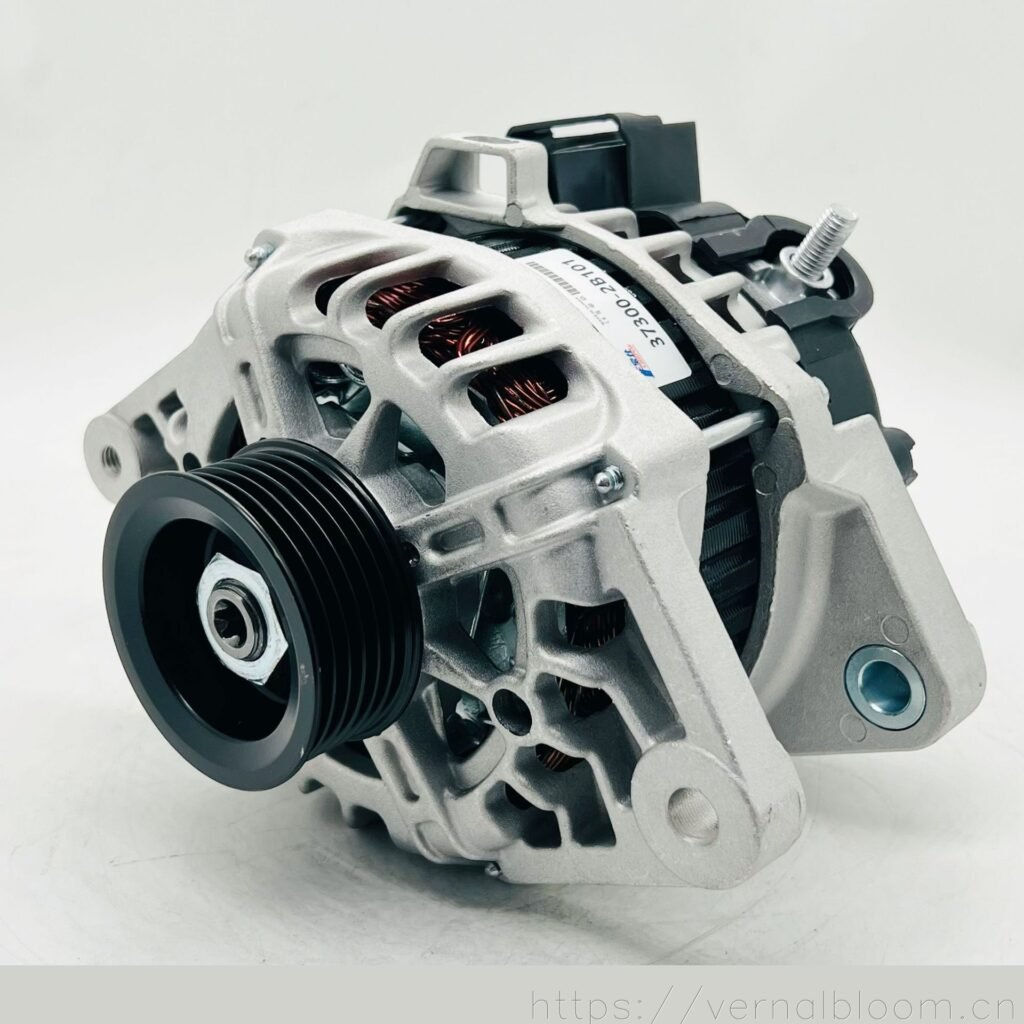
1. Classification by Structural Design
This is the most common technical classification for automotive alternators, based on how the internal cooling fans, rectifiers, and regulators are integrated.
- Ordinary/Standard Alternator: The traditional design where the cooling fan is mounted externally on the front shaft near the pulley. It is simple but less efficient at cooling high-output units.
- Integral Alternator: An alternator that integrates the electronic voltage regulator inside the rear housing, creating a single, self-contained unit. Most modern vehicles use this configuration.
- Pump Alternator : Commonly found on older diesel vehicles, this type features a mechanical vacuum pump attached directly to the rear of the alternator shaft to assist with braking systems.
- Brushless Alternator: Instead of using carbon brushes and slip rings to transfer field current to the rotor, it utilizes a dedicated exciter winding. These are highly durable and primarily used in heavy-duty commercial trucks, marine engines, and industrial generators because they require less maintenance.
2. Classification by Rotor Pole Design & Wiring
This classification targets the electrical architecture inside the unit.
| Type | Description | Key Application |
|---|---|---|
| 6-Diode Alternator | Features a standard 3-phase bridge rectifier using 6 power silicon diodes to convert AC to DC. | Standard passenger cars. |
| 8-Diode Alternator | Includes 2 additional diodes connected to the stator’s neutral point to capture residual energy and boost output by 10% to 15% at high RPMs. | Vehicles with higher baseline electrical loads. |
| 11-Diode Alternator | Utilizes 9 power diodes plus 3 smaller field excitation diodes (often called a diode trio) to self-excite the rotor circuit independently of the battery once running. | Heavy-duty or specialized industrial applications. |
3. Classification by Cooling and Housing Type
As electrical demands inside modern engine bays increase, cooling methods have split into two main paths:
- Open / Air-Cooled (风冷式): Uses one or two internal/external fans to pull ambient air through the housing. It is cost-effective and standard for most passenger vehicles.
- Liquid-Cooled / Water-Cooled (水冷式): Encased in a jacket connected to the engine’s coolant loop. These are completely sealed, highly quiet, and found in premium luxury vehicles with massive electrical loads where engine bay space restricts air cooling.
4. Classification by Application and Voltage
From a B2B procurement and trade perspective, alternators are almost always cataloged by their target vehicle segment and system voltage:
- Passenger Car Alternators (12V / 14V): Ranges from 60A to over 250A. Optimized for tight engine compartments and high-RPM civilian driving.
- Commercial Vehicle & Heavy-Duty (24V / 28V): Used for large buses, transport trucks, and agricultural machinery. These focus on low-RPM high-torque durability and continuous high-current delivery.
- Mild-Hybrid Alternators / BAS (48V): Belt-Alternator Starter systems. These serve a dual purpose: they act as a high-output generator to charge 48V lithium systems and can reverse roles to act as an electric motor to assist the engine during start-stop cycles.
Regular alternators use carbon brushes and are heavy compared to high output alternators. They have a shorter life and produce a low voltage at high speeds. The brushes wear out quickly compared to high-output alternators and can lead to overheating. However, they are capable of powering the electrical and other accessories of a vehicle, and they come standard in most vehicles.